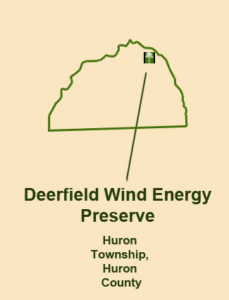
Deerfield Wind Energy Preserve
12.35 Acres
Huron Township, Huron County
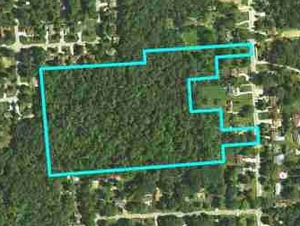
12.35 Acres
Huron Township, Huron County
From 2016 through 2022, the TLC contracted with Algonquin Power Company of Oakville, Ontario, Canada to provide stewardship of their 12.35-acre Deerfield Wind Energy Preserve, about 4 miles west of Port Hope. The Deerfield Wind Energy Preserve was placed under a State conservation easement as mitigation for wetland impacts resulting from the nearby Deerfield Wind Energy turbine project. 1.235 acre of State-regulated forested wetland was permanently converted to open wetland for the purpose of clearing a 60-foot wide right-of-way for an electrical transmission line. The Michigan Department of Environmental Quality allows preservation of existing wetland, at a 10 to 1 ratio, as mitigation for permitted wetland impacts. As with the TLC Dead End Woods and Peltier Beach Ridge Sanctuaries in Fort Gratiot Township in Saint Clair County, the Deerfield Wind Energy preserve was placed under a State conservation easement as mitigation for permitted wetland impacts. The MDEQ required, and now Michigan Department of Environment, Great Lakes, and Energy requires, long-term stewardship on all mitigation sites, usually provided by land conservancies like the TLC.
Most of the Deerfield Wind Energy Preserve is southern swamp forest with species trending somewhat toward a northern community. Dominant vegetation includes Silver Maple, Black Ash saplings and seedlings, Sensitive Fern, Spinulose Woodfern, Wood Nettle, Clearweed, Lake Sedge, and other sedges. Small upland areas are dominated by Red Maple, Wild Black Cherry, American Basswood, and, unfortunately, Japanese Barberry. Uncommon native plant species include Foamflower, Swamp White Oak, Turtlehead, Woodreed Grass, Spicebush, Cardinal Flower, Round leaved Pyrola, and Red Trillium. The preserve is part of one of the larger forest fragments remaining in the Thumb, almost continuous along tributaries of Willow Creek to Lake Huron. As such, it is not only important for the watershed, but as habitat for migratory birds. Those observed on the preserve include Wood Thrush, Veery, Eastern Wood-pewee, Evening Grosbeak, many American Redstart warblers, Common Yellowthroat warbler, Yellow Warbler, Black-capped Chickadee, Downy Woodpecker, and Catbird.
The most immediate stewardship issue on the Deerfield Wind Energy Preserve was determined to be a dense growth of invasive Japanese Barberry along roughly 600 feet of the east preserve boundary, extending about 100 feet west into the forest before decreasing to a few scattered shrubs. The barberry growth apparently exploded in the past few years as a result of forest clearing on the adjacent parcel east to expand a hay field. The clearing greatly increased the amount of light exposure in the remaining forest, shifting edge forest conditions at least another 100 feet west into the preserve.
The TLC proceeded with extensive manual clearing of the barberry in the fall of 2017, as opposed to herbicide application, after determining that native forest plants under and around the barberry would likely be eliminated by herbicide. These species include Foamflower, Turtlehead, Red Trillium, Round leaved Pyrola, and Canada Mayflower. Deer ticks are known to concentrate in barberry, much of it head-high on the preserve, which could present a risk of Lyme Disease to stewards cutting or digging barberry in the summer. To minimize Lyme Disease risk and destruction of native woodland herbs, the TLC has limited most of our work to the fall, winter, and early spring. Starting in early September of 2016, the TLC began cutting barberry shrubs with hand loppers and a gas-powered weed whacker fitted with a 4-point steel brush blade. Over 1 acre of barberry was initially cut along the east side of the preserve. In the early spring of 2018, the TLC started burning the cut barberry stems with propane weed torches. Repeated for a few years, most of the barberry was eventually killed in the burn area, which approached 3 acres. Some barberry stems were manually pulled or dug from the ground.
As with other stewardship sites, the TLC conducted species inventories, detailed measurements of vegetation in sampling plots across the preserve, general observation, and extensive photographic documentation as part of the annual monitoring required by the MDEQ.