MAJOR PROJECTS
Southern Lake Huron Coastal Park
500 Acres, Fort Gratiot and Burtchville Townships, Saint Clair County
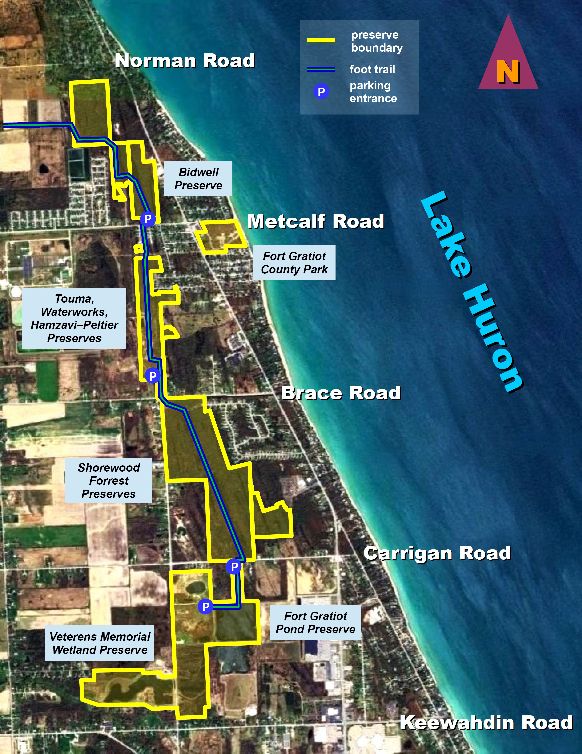
From its founding in 2008, the TLC has worked to create the Southern Lake Huron Coastal Park, a group of mostly connected preserves now extending over 3 miles and approaching 500 acres along the shoreline of Lake Huron north of Port Huron. The Southern Lake Huron Coastal Park protects the largest occurrence of imperiled dune and swale forest from the Ohio border to Saginaw Bay; a complex of parallel sand ridges and muck wetlands deposited from about 4,500 years ago. This coastal dune and swale forest supports rare plant and animal species such as Purple-flowering Raspberry (the Lower Peninsula version of the Upper Peninsula’s Thimbleberry), Yellow Ladyslipper orchid, Butternut, Eastern Hognose Snake, Blanding’s Turtle, Blue-spotted Salamander, and other uncommon species. The coastal forest is vital for migratory birds that move and nest along Lake Huron. The Southern Lake Huron Coastal Park is likely to become a major local recreational attraction and regional destination for birders, naturalists, and other visitors. When completed, the Southern Lake Huron Coastal Park could include 800 acres and will include a 4.5-mile long trail connecting Fort Gratiot with the day-use area of Lakeport State Park.
The TLC has worked with the Saint Clair County Drain Commissioner, Ducks Unlimited, and Presbyterian Villages of Michigan, among other partners, to expand, protect, and restore the Southern Lake Huron Coastal Park. Funding partners have included The Carls Foundation, Consumers Energy Foundation, Community Foundation for Southeast Michigan, Community Foundation of Saint Clair County, Franklin H. & Nancy S. Moore Donor Advised Fund, Cargill Salt of Saint Clair, Cargill, Incorporated, Ducks Unlimited, North American Wetlands Conservation Council, Bioregion Reparation Fund, SEMCO Energy Gas Company, and individual donors including the Touma family.
As of 2025, the TLC owns and stewards six preserves totaling 166 acres within the park, and has constructed about 2.5 miles of the planned 4.5-mile coastal trail. Stewardship work has consisted mostly of invasive shrub removal, like Common Privet, Tartarian Honeysuckle, and Japanese Barberry. The TLC is also attempting to propagate native plant species of the original dune and swale forest, including Tamarack, Northern White-cedar, Spikenard, and Yellow Lady slipper orchid.
The TLC is currently working to acquire at least three more critical parcels, totaling over 170 acres, in the Southern Lake Huron Coastal Park project area to expand and secure the connectivity of the park and dune and swale forest as a whole. Without these parcels, it will be impossible to connect the south, middle, and north portions of the Southern Lake Huron Coastal Park.
Morley Sanctuary
113 Acres, Bangor Township, Bay County
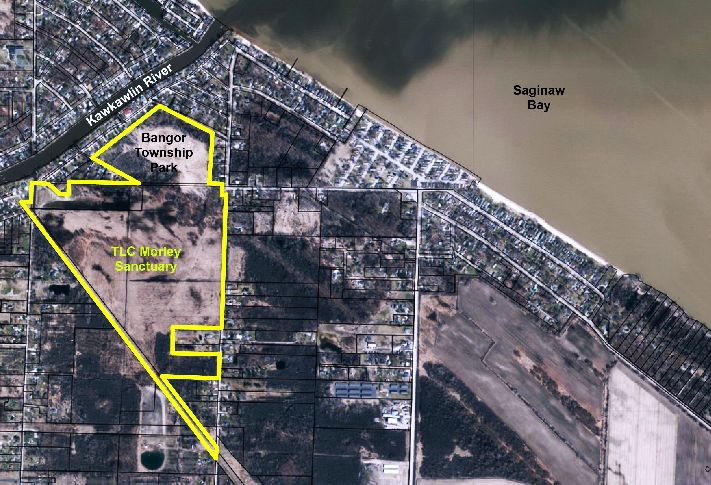
Thanks to a Wetland Conservation Program grant provided by Ducks Unlimited and the Michigan Department of Natural Resources, the TLC acquired the 113-acre Morley Sanctuary in 2025. The Morley Sanctuary consists of about 95 acres of imperiled lakeplain prairie along the south side of the Kawkawlin River, only a half-mile west of Saginaw Bay; one of the larger intact occurrences of lakeplain prairie that remained unprotected in the Bay City area. Lakeplain prairie is a species-rich grass-dominated plant community on generally sandy soils near the Great Lakes shoreline, maintained by seasonal flooding, cyclical variations in Great Lakes water levels, and fire during dry periods. Saginaw Bay lakeplain prairie remnants provide habitat for many rare species like US Threatened and Michigan Endangered Prairie White-fringed Orchid, Michigan Threatened Sullivant’s Milkweed, and Michigan Threatened Tall Green Milkweed. In Michigan, lakeplain prairie was historically limited to shoreline counties of the southeast Lower Peninsula, and now reduced to less than 1% of its former range. Much of the original lakeplain prairie occurred along the Saginaw Bay, and in the heavily developed Bay City area, long since eliminated by farming, drainage, and development.
About 8 acres of the Morley Sanctuary consists of wooded beach or dune ridges covered by large Black Oak, possibly with Hill’s Oak hybrids, and a few White Oak, most appearing to be around 100 years old. A long, winding sand ridge with scattered oaks extending through the middle of the Morley Sanctuary is particularly scenic; a wild and windy peninsula with a great view of the adjoining prairie to the north, south, and east.
About 10 acres along the west side of the Morley Sanctuary is the former Detroit and Mackinac Railroad bed, now a paved rail trail. The trail provides excellent public access and connects with the nearly 2,400-acre Bay City State Park about one-half mile north. The Morley Sanctuary is also connected by a paved trail to the 415-acre Bay City Ecological Restoration property one-half mile east at the mouth of the Saginaw River. The Morley Sanctuary even contains the remnants of an historic open-pit coal mine dating back to the late 1800s. An old railroad spur bed is still visible across the preserve where coal was hauled to the main track of the Detroit and Mackinac Railroad.
TLC stewardship on the Morley Sanctuary will include removal of invasive weeds, particularly Phragmites Reed and Glossy Buckthorn, hopefully prescribed burning to help restore the native plant community, and propagation of native lakeplain plants.
The TLC is working with Bangor Township on development of a parking area, trails, benches, information kiosks, pavilions, and a kayak and canoe launch to the Kawkawlin River.