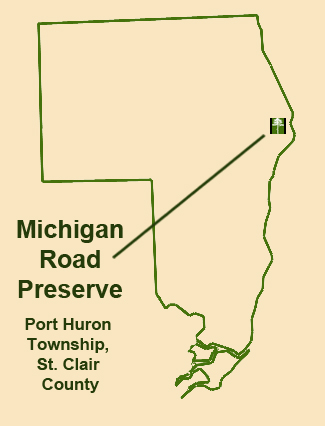
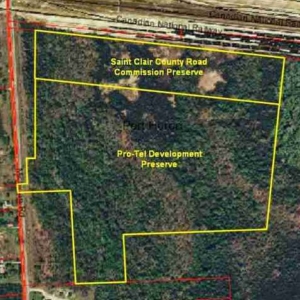
From 2011 through 2015, the TLC contracted with the Saint Clair County Drain Commissioner, Saint Clair County Road Commission and Pro-Tel Development to provide five years of annual monitoring and stewardship required by the Michigan Department of Environmental Quality as a condition of two wetland permits issued to the SCCRC and Pro-Tel Development. The SCCRC permit authorized impact of 0.57 acre of emergent marsh and 0.14 acre of shrub swamp wetland for the removal of the old Michigan Road crossing of the North Branch of Bunce Creek, and replacement of the crossing structure with a new bridge over the Canadian National Railway in Port Huron Township. The Pro-Tel Development permit authorized impact of 2.85 acres of wetland and relocation of 950 linear feet of the Read Drain for the purpose of commercial development at the southeast corner of Wadhams Road and Griswold Road in Kimball Township. In total, the MDEQ required preservation of 31.08 acres of existing natural wetland as mitigation for the permitted impacts. The SCCRC and Pro-Tel Development provided the required preservation on two adjacent parcels totaling just over 51 acres and the SCCDC subsequently accepted ownership of the land.
The TLC inspected the conservation easement site annually for five years, documented site conditions, identified management concerns, and conducted stewardship activities according to the requirements of the MDEQ permits and management plans produced by the TLC. Annual monitoring and stewardship reports included detailed vegetation data from sampling plots, descriptions of ecological conditions, vegetative development, human and natural disturbance, litter and refuse dumping, invasive species control results, controlled burn effects, native plantings, ecological enhancement, easement sign conditions, potential safety hazards, adjoining land use, a summary of annual management and maintenance activities, and extensive on-site
photographs. Monitoring reports also included comparisons of current site conditions to those of previous years, descriptions of changes observed, and evaluation of the effectiveness of long-term management actions.
The Michigan Road Preserve is just 51 acres of a much larger northern woodland complex on upland sand ridges and lower wetland east of Michigan Road, north of Dove Road and along the south side of the Canadian National Railroad. Sand ridges are relatively broad, a few hundred feet in width, appearing to be Rousseau fine sands. Adjacent lower and wetter soils are Wainola-Deford fine sands. Most of the preserve is typical of relatively young woodland in the Port Huron area, recovering over the past 70 to 90 years after much of the area was cleared for timber. The forest community is composed of northern species like Red Maple, Paper Birch, Wintergreen, Bracken Fern, Wild Sarsaparilla, and Canada Mayflower mixed with southern species like Black Oak and Smooth Highbush Blueberry. The central and eastern portions of the Michigan Road Preserve are covered by disturbed northern shrub swamp dominated by Tag Alder, Black Chokeberry, and Glossy Buckthorn, with Narrow-leaved Cat-tail and Reed in the lowest and more open areas.
Despite clearing decades ago, the Michigan Road Preserve retains many species characteristic of the vegetation that existed before Euro-American settlement. The composition of the forest community on the preserve, like much of the forest in the Port Huron area, is a diverse blend of northern and southern flora, being located at a southern extension of Michigan’s Transition or Tension Zone along the Lake Huron coast, with a moderated climate. The habitat across much of the Michigan Road Preserve appears well suited for Michigan Endangered Painted Trillium – Trillium undulatum, known from other sites nearby. Painted Trillium is one of nearly 40 species of trillium native to North America, about 10 of which are found in Michigan. Saint Clair County is an isolated outpost for Painted Trillium on the western edge of its range in North America, reflecting the Blue Water Area’s unique natural history. Its primary range is the Appalachian Mountains at higher elevations on organic soils, in rhododendron and Mountain Laurel thickets or Red Spruce groves, but nowhere is it considered common. In Saint Clair County, Painted Trillium is recorded only from mesic northern forest, on moist sands. Its occurrence strongly coincides with the interface of Rousseau fine sand or Chelsea-Croswell sand ridges and the lower and wetter Wainola Deford fine sands, such as on the Michigan Road Preserve. Plants are often found along the base of sand ridges, near wetland. Painted Trillium also shows a strong affinity for distinct and dense tip-up mounds like those on the Michigan Road Preserve. Painted Trillium was first documented in Saint Clair County around 1900 by botanist, attorney, and city controller of Port Huron, Charles K. Dodge.
A few small patches of Marsh Saint John’s-wort – Triadenum fraseri occur in the shrub swamp in the central part of the preserve. This is a northern species not often encountered in Saint Clair County, but more common in northern Michigan. Marsh Saint John’s-wort is indicative of wet sandy soils, occurring in alder thickets, such as the Michigan Road Preserve, but also bogs and sedge meadows, suggesting it may be remnant of a more open, fire-maintained community.
Three invasive weeds are a management concern on the preserve, including Reed – Phragmites australis subspecies australis, Glossy Buckthorn – Frangula alnus, and Narrow-leaved Cat-tail – Typha angustifolia. Reed is limited to the open shrub swamp areas in the central and eastern parts of the preserve where it is mingled with Glossy Buckthorn, Black Chokeberry, and Tag Alder. Narrow-leaved Cat-tail covers far less area and is very limited, in only the few open patches in the north-central part of the preserve. Neither Reed nor Narrow-leaved cat-tail are spreading as they already occupy the full extent of open habitat on the preserve. Glossy Buckthorn, however, while fairly widespread across the open shrub swamp, is still spreading in the swamp forest. It is a
co-dominant species of the forest understory across about a third of the preserve and is the greatest management concern.
There appear to be few direct, recent human impacts on the Michigan Road Preserve. There are no trails on the preserve, being fairly well isolated by the North Branch of the Bunce Creek to the southwest, the Canadian National Railway to the north, and extensive forest to the east and south. Because wetland is so extensive in this area, there are few nearby residences, which is probably another factor in the lack of disturbance. Apparently for the same reasons, there is little refuse.
In the fall of 2011, land adjoining the west side of the preserve was completely cleared for the railroad crossing construction authorized by the same MDEQ permit that the Michigan Road Preserve provides wetland mitigation for. In response to the increased light, Glossy Buckthorn density and growth exploded along the west boundary of the preserve.
The adjacent forest clearing caused further degradation through yet more deforestation and by extending edge effects at least another 100 feet into the preserve. Forest quality is very dependent on maintaining large, unfragmented tracts that are less susceptible to invasion of edge and weed species. Large unfragmented forests are better able to maintain interior forest species, remnants of prehistoric populations that thrived prior to European settlement 150 to 200 years ago. The loss of adjacent forest made the preserve that much more unsustainable in the long term. With less forest, full sunlight extends further into the remaining forest, favoring weedy edge species over the remnant native flora. Wind-throw of mature trees from prevailing west winds will extend further into the preserve. Interior forest birds such as Wood Thrush are particularly vulnerable to nest invasion and territorial displacement by Cowbirds and other birds of open habitat and edge woodlands.
The TLC conducted several management activities on the Michigan Road Preserve to control invasive Glossy Buckthorn and to improve the native flora by reintroduction of a natural fire regime that characterized this type of forest community prior to European settlement. With the assistance of the Port Huron Township Fire Department, the TLC conducted two small controlled burns on 2014 April 12. Subsequent inspections of the preserve indicated that the burning was moderately effective in eliminating Glossy Buckthorn seedlings. Based on this, the TLC conducted a much larger burn on the preserve the following spring, on 2015 May 01. The burn was conducted without the PHTFD, but with new TLC intern, Alex Roland, from Saint Clair County Community College, her friend, Brook, and a few TLC board members. The natural fuel load (leaves and twigs) was greater and weather conditions were much more favorable that day to
sustaining a good burn. The results of the burn were evaluated later in August, with the assistance of TLC interns Alex Roland, Jeff Hansen, and Nicole Barth, all students at SC4. An additional decrease in Glossy Buckthorn was observed, but with a significant increase in Black Cherry seedlings. Whether most of these seedlings would survive and eventually dominate the forest understory was uncertain. This could be a negative effect of burning, as well as our inability to burn Glossy Buckthorn in the lower and wetter portions of the wetland. A positive effect however, appeared to be increased density of fire-tolerant northern plant species, such as Bunchberry and Gay-wings, which would originally have likely been a larger component of the forest community before Euro-American settlement.