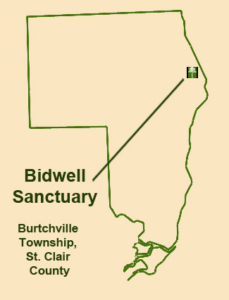
Bidwell Sanctuary
42.1 Acres
Burtchville Township, Saint Clair County
Acquired 2020 July 17
Chëkhònèsink hìtkwike schind lèkuwake – Place Among Hemlock Trees on Sandy
Ground Where There is Sound of Waves Breaking – Lenape
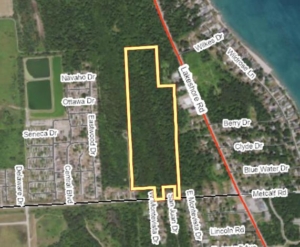
42.1 Acres
Burtchville Township, Saint Clair County
Acquired 2020 July 17
Chëkhònèsink hìtkwike schind lèkuwake – Place Among Hemlock Trees on Sandy
Ground Where There is Sound of Waves Breaking – Lenape
The Bidwell Sanctuary is one of the best examples of dune and swale forest remaining along the eastern shoreline of the Thumb. Acquisition of the Bidwell Sanctuary was a major preservation accomplishment for the TLC on behalf of the Blue Water Area.
Major project funders included The Carls Foundation of Bloomfield Hills, the Community Foundation for Southeast Michigan, the Consumers Energy Foundation, Cargill, Inc. and Cargill Salt of Saint Clair, the Community Foundation of St. Clair County, the Franklin H. and Nancy S. Moore Donor Advised Fund of the Community Foundation of St. Clair County, and SEMCO Energy Gas Company of Port Huron.
The Bidwell Sanctuary is an important part of the proposed Southern Lake Huron Coastal Park, a band of several preserves and parks extending along Lake Huron through Fort Gratiot and Burtchville Townships. The preserves are generally inaccessible to the public and somewhat disconnected from each other, but not by much. The TLC is within reach of creating a continuous 4.5-mile coastal park and trail connecting the Port Huron area to the day-use area of Lakeport State Park. The Southern Lake Huron Coastal Park would encompass most of the remaining dune and swale forest from Lake Erie to the tip of the Thumb. Once connected, the Southern Lake Huron Coastal Park is likely to become a regional destination for bicyclists, birders, naturalists, and other visitors.
The dune and swale forest complex is a very unique formation of parallel sand ridges
and muck wetlands that formed about 4,500 years ago as the high water of the early Great Lakes quickly receded. After being depressed for thousands of years by glacial ice about 2 miles thick, the land in our region began rising as the last glacier melted back. The land is still rising slightly. As the land rose, the old Georgian Bay outlet of the early Great Lakes was blocked. The Nipissing stage of early Lake Huron rose about 15 feet above the present elevation. Great Lakes water was still draining through the old Chicago outlet, but then redirected to the Saint Clair River outlet which quickly downcut. The high water rapidly drained, leaving a series of parallel sand ridges separated by mucky wetland troughs or swales from about 2 miles inland to the present shoreline.
The ridges were wind-blown dunes and the mucky swales were shrub swamp for a long
time before becoming forested and covered largely by cedars. The dune and swale forest complex provides critical shoreline habitat for uncommon and rare plant and animal species found in few other parts of Michigan, such as Purpleflowering Raspberry, almost identical to Thimbleberry of the Upper Peninsula, Yellow Lady-slipper orchid, Pink Lady-slipper orchid, Eastern Hognose Snake, and Blue-spotted Salamander, as well as a great abundance of migratory birds that move and nest along Lake Huron.