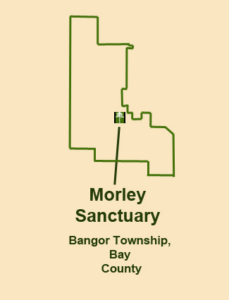
Morley Sanctuary
113 Acres
Bangor Township, Bay County
Acquired 2025 February 26
113 Acres
Bangor Township, Bay County
Acquired 2025 February 26
On February 26, the TLC purchased our new 113-acre Morley Sanctuary in Bangor Township, Bay County on the north side of Bay City. The closing took place at Superior Title Agency in Bay City. Representing the TLC were Executive Director Bill Collins, President Cheryl Collins, Program and Stewardship Director Teddy Wiley, and Land Agent Dave Ladensack. Representing the sellers were Kathy Richards and Sean Mika, children of previous owner Jack Morley. After the closing, we had a nice discussion and presented Kathy and Sean with our TLC patches. Kathy Richards asked that we memorialize her father Jack Morley and his wife Cheryl at the entrance of the sanctuary, which we will gladly do. She presented us with these words:
“Joy, Peace, and Tranquility to all who pass through, not just pass by.”
“Life leads us down many paths. As you walk through these paths, our hope is that they bring you Peace, Joy, and Tranquility. In memory of Jack and Cheryl Morley.”
Picture
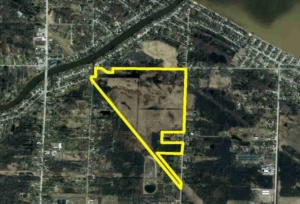
The TLC Morley Sanctuary in yellow along the south side of the Kawkawlin River, near its outlet to Saginaw Bay. The Saginaw River mouth is about 1.5 mile east. Google Earth 2011 photograph.
While slightly outside of the core TLC mission territory, the Morley Sanctuary is a very worthy project that called for action. The Morley Sanctuary consists of about 95 acres of imperiled lakeplain prairie along the south side of the Kawkawlin River, only a half-mile west of Saginaw Bay; one of the larger intact occurrences of lakeplain prairie that remained unprotected in the Bay City area. Lakeplain prairie is a species-rich grass-dominated plant community on generally sandy soils near the Great Lakes shoreline, maintained by seasonal flooding, cyclical variations in Great Lakes water levels, and fire during dry periods, and providing habitat for many rare species like Prairie Fringed Orchid, Sullivant’s Milkweed, and Tall Green Milkweed. In Michigan, lakeplain prairie was historically limited to shoreline counties of the southeast Lower Peninsula, now with less than 1% remaining across its range. Much of the original lakeplain prairie occurred along the Saginaw Bay, and in the heavily developed Bay City area, long since eliminated by farming, drainage, and development.
TLC Morley Sanctuary plant community and feature map. 2024 photograph. Fetch GIS Bay County: https://app.fetchgis.com/bay
Picture
Lakeplain prairie south of the central wooded beach or dune ridge. Photograph by Teddy Wiley.
About 8 acres of the sanctuary consists of wooded beach or dune ridges covered by large Black Oak, possibly with Hill’s Oak hybrids, and a few White Oak, most appearing to be around 100 years old. A long, winding sand ridge with scattered oaks extending through the middle of the Morley Sanctuary is particularly scenic; a wild and windy peninsula with a great view of the adjoining prairie to the north, south, and east.
Picture
Central wooded sand ridge on the Morley Sanctuary. Photograph by Teddy Wiley.
About 10 acres along the west side of the Morley Sanctuary is an old railroad bed of the former Detroit and Mackinac Railroad with a paved rail trail. The trail provides excellent public access to the sanctuary and connects with the nearly 2,400-acre Bay City State Park just over one-half mile to the north. The Morley Sanctuary is also connected by a paved trail to the 415-acre Bay City Ecological Restoration property one-half mile east at the mouth of the Saginaw River.
The Morley Sanctuary even contains the remnants of an historic open-pit coal mine dating back at least to the late 1800s. The pit has since been largely filled and is partially a pond. An old railroad spur bed is still visible across the lakeplain prairie where coal was hauled from the pit to the main section of the Detroit and Mackinac Railroad.
Protection of the Morley Sanctuary was over 10 years in the making, dating back even 30 to 40 years considering regulatory action by the Michigan Department of Natural Resources and later biological survey work by the Michigan Natural Features Inventory. In 2015, TLC Executive Director Bill Collins, then employed as a wetland consultant with Huron Ecologic, LLC, was hired by the former landowner, Jack Morley, to plan and coordinate wetland restoration and to provide expert testimony on his behalf. At that time, the Michigan Department of Environmental Quality and Michigan Attorney General had already taken multiple enforcement actions over the course of about 6 years for wetland violations on the property. Seeing that much of the lakeplain prairie and associated beach ridges was still largely intact, Bill tried to persuade Jack to consider various land-use alternatives that would protect the natural community while providing an income and a public benefit.
As part of a 4-acre wetland restoration and planting required by the Michigan Department of Environmental Quality, Bill and Cheryl Collins, with the help of TLC Board Member Dan Rhein, collected native plant seed from across the Morley property and nearby lakeplain prairie remnants. During this seed collection in 2016 through 2018, it was evident that the Morley lakeplain prairie, despite having been partially farmed, was still quite species-rich. Many species characteristic of lakeplain prairie were identified on the Morley property, including the following:
Agalinis purpurea – Purple False Foxglove
Agalinis tenuifolia – Common False Foxglove
Andropogon gerardii – Big Bluestem grass
Andropogon virginicus – Broom-sedge
Anemone virginiana – Thimbleweed
Asclepias incarnata – Swamp Milkweed
Asclepias syriaca – Common Milkweed
Asclepias tuberosa – Butterfly-weed
Calamagrostis canadensis – Blue-joint Grass
Carex lacustris – Lake Sedge
Carex stricta – Tussock Sedge
Coreopsis tripteris – Tall Coreopsis
Cornus ammomum – Silky Dogwood
Cornus foemina – Gray Dogwood
Eupatorium perfoliatum – Common Boneset
Euthamia graminifolia – Grass-leaved Goldenrod
Eutrochium maculatum – Joe-pye Weed
Gentianopsis crinita – Fringed Gentian
Helenium autumnale – Sneezeweed
Juncus torreyi – Torrey’s Rush
Liatris spicata – Marsh Blazing-star
Mimulus ringens – Monkey-flower
Oenothera biennis – Common Evening-primrose
Panicum virgatum – Switch Grass
Penstemon digitalis – Foxglove Beard-tongue
Potentilla anserina – Silverweed
Pycnanthemum virginianum – Common Mountain Mint
Rudbeckia hirta – Black-eyed Susan
Schizachyrium scoparium – Little Bluestem grass
Sisyrinchium angustifolium – Stout Blue-eyed Grass
Solidago riddellii – Riddell’s Goldenrod
Sorghastrum nutans – Indian Grass
Spartina pectinata – Cordgrass
Spiranthes cernua – Nodding Ladies’-tresses
Symphyotrichum lanceolatum – Panicled Aster
Symphyotricum novae-angliae – New England Aster
Thalictrum dasycarpum – Purple Meadow-rue
Verbascum thapsus – Common Mullein
Verbena hastata – Blue Vervain
Picture
Marsh Blazing-star – Liatris spicata remnant along the highly disturbed wetland
restoration area. Photograph by Bill Collins.
Limited farming across portions of the lakeplain prairie on the property from 2009 through 2015 resulted in temporary and varying dominance of:
Agalinis tenuifolia – Common False Foxglove
Ambrosia artemisiifolia – Common Ragweed
Conyza canadensis – Horseweed
Eupatorium perfoliatum – Common Boneset
Panicum capillare – Witch Grass
Verbena hastata – Blue Vervain.
By 2019, the 4-acre wetland restoration was completed and there has been little to no activity on the Morley property since.
The Morley Sanctuary contains extensive habitat for several rare plant species recently observed and documented in Bay County, including:
US Threatened and Michigan Endangered:
Platanthera leucophaea – Prairie White-fringed Orchid
Michigan Endangered:
Platanthera ciliaris – Yellow-fringed Orchid
Silene virginica – Fire Pink
Michigan Threatened:
Asclepias hirtella – Tall Green Milkweed
Beckmannia syzigachne – Slough Grass
Michigan Special Concern:
Arnoglossum plantagineum – Prairie Indian-plantain
Astragalus neglectus – Cooper’s Milk vetch
Juncus dichotomus – Forked Rush
Trichophorum clintonii – Clinton’s Bulrush
Two rare species documented from lakeplain prairie in Tuscola County include:
Michigan Threatened:
Asclepias sullivantii – Sullivant’s Milkweed
Cypripedium candidum – White Lady’sslipper
Rare animal species recently observed and documented in Bay County that could occur on the Morley Sanctuary include:
Michigan Endangered:
Bombus pensylvanicus – American Bumble Bee
Centronyx henslowii – Henslow’s Sparrow
Rallus elegans – King Rail
Michigan Threatened:
Callophrys irus – Frosted Elfin butterfly
Erynnis persius persius – Persius Dusky Wing butterfly
Ixobrychus exilis – Least Bittern
Michigan Special Concern:
Bombus borealis – Northern Amber Bumble Bee
Bombus terricola – Yellow Banded Bumble Bee
Botaurus lentiginosus – American Bittern
Circus cyaneus – Northern Harrier
Cistothorus palustris – Marsh Wren
Emydoidea blandingii – Blanding’s Turtle
Eucosma bipunctella – Two-spotted Eucosma moth
Haliaeetus leucocephalus – Bald Eagle
Nycticorax nycticorax – Black-crowned Night-heron
Pandion haliaetus – Osprey
Rare species documented from lakeplain prairie in Tuscola County include:
Michigan Threatened Papaipema silphii – Silphium Borer Moth
Michigan Special Concern Papaipema sciata – Culvers Root Borer moth
There are also several other insect species documented from lakeplain prairie of conservation concern due to their reliance on remnant prairie sites or particular host plants. During their brief 1994 survey of about 30 acres of the Morley property, the Michigan Natural Features Inventory identified at least 27 insect species in seven families, three of which require specific plant species hosts.
Bird watchers in the nearby Bay City State Park, just over one-half mile north of the Morley Sanctuary, have documented over 250 bird species sightings on eBird.org, including:
US and Michigan Endangered
Piping Plover – Charadrius melodus
Michigan Endangered
Short-eared Owl – Asio flammeus
Michigan Threatened
Eastern Whippoor-will – Antrostomus vociferus
Least Bittern – Botaurus exilis
Black Tern – Chlidonias niger
Evening Grosbeak – Coccothraustes vespertinus
Peregrine Falcon – Falco peregrinus
Common Gallinule – Gallinula galeata
Common Loon – Gavia immer
Caspian Tern – Hydroprogne caspia
Cerulean Warbler – Setophaga cerulea
Kirtland’s Warbler – Setophaga kirtlandii
Forster’s Tern – Sterna forsteri
Golden-winged Warbler – Vermivora chrysoptera
Michigan Special Concern
American Bittern – Botaurus lentiginosus
Red-shouldered Hawk – Buteo lineatus
Northern Harrier – Circus hudsonius
Marsh Wren – Cistothorus palustris
Trumpeter Swan – Cygnus buccinator
Red-headed Woodpecker – Melanerpes erythrocephalus
Osprey – Pandion haliaetus
Wilson’s Phalarope – Phalaropus tricolor
Prothonotary Warbler – Protonotaria citrea
Hooded Warbler – Setophaga citrina
Yellow-headed Blackbird – Xanthocephalus xanthocephalus
Many of these same bird species could be expected to occur on the Morley Sanctuary.
Before Euro-American settlement, the Morley Sanctuary consisted of lakeplain wetland interspersed with upland beach or dune ridges and smaller upland sand knolls or minor ridges.
Vegetation mapping produced by the Michigan Natural Features Inventory, based on the General Land Office survey notes of the 1800s, indicates that wetland on and near the Morley Sanctuary was significantly wetter, consisting largely of marsh and shrub swamp.
Lakeplain wet prairie was likely a component of the larger plant community complex, especially during low levels of the Saginaw Bay. Upon agricultural drainage, wet-mesic prairie would have expanded across the vicinity while smaller areas of interspersed marsh persisted.
Many plant species associated with lakeplain wet prairie were likely present originally, while others may have spread from nearby lakeplain prairie following partial drainage. Historic mapping by the US Geologic Survey indicates wetland across the northern portion of the Morley Sanctuary in 1916 and 1919. By 1938, an aerial photograph shows that a ditch had been excavated through the northwest of the property, which would have depleted seasonal wetland hydrology, especially during low water levels in Saginaw Bay. More ditches were dug and by 1967, the only wetland shown on the USGS mapping is in the northeast corner of the property. Despite extensive ditching on the Morley Sanctuary and vicinity, wetland hydrology is still significantly influenced by Saginaw Bay. During the highest lake levels, there is speculation that ditching may even result in greater influx of water to the property and increased wetland hydrology.
Although the wetland is extensive, it has been degraded by historic farming and on-site ditching that drains to two county drains; the Frank Jean Drain on the east and the Corbin Drain on the west side of the preserve. The Corbin Drain Branch extends through the northwest corner of the site and connects to the Corbin Drain. These drains discharge to the Kawkawlin River, only a few hundred feet north of the Morley Sanctuary, and into Saginaw Bay, which is only about a half-mile east. Despite extensive drainage, wetland has persisted, and except for limited farming which ended in 2016, and about 4 acres of wetland restoration completed in 2019, there appear to be few other direct and recent human impacts.
In 2009, the Michigan Department of Environmental Quality determined that 92 acres (81%) of the Morley property was State-regulated wetland. The same wetland should be federally regulated by the United States Environmental Protection Agency and the United States Army Corps of Engineers due to its connection with the Kawkawlin River and Saginaw Bay, although federal wetland jurisdiction is now at-risk of being largely eliminated. Wetland and other federal regulations and rules have been severely limited by recent US Supreme Court decisions with more review anticipated in the near future. It’s very possible that much of the legal basis for wetland protection in Michigan, which assumed substantial jurisdiction over federally regulated wetland in 1983, could be eliminated by judicial review, change in State administration, and legislative action. State of Michigan wetland protections may also be in jeopardy from efforts to harmonize with federal regulation, or lack thereof. In addition, low staffing and funding has always limited wetland regulation.
On a federal level, farming of wetland has generally never been prohibited except for those farmers participating in US Department of Agriculture crop subsidy and insurance programs. Wetlands that do not need to be cleared of trees and shrubs, and are not substantially drained, can be farmed with no penalties, and many farming and livestock activities are exempt from regulation. On a State level, farming wetland is restricted, but there are provisions in State law to allow it.
Given the limitations on wetland protection and the largely dismal outlook for regulation, the TLC was quite justified in acquiring the Morley Sanctuary.
Soil disturbance due to ditching and cultivation, along with fire suppression, has favored the establishment and expansion of invasive weeds on the Morley Sanctuary including Reed Canary Grass – Phalarus arundinacea, Purple Loosestrife – Lythrum salicaria, and invasive Reed – Phragmites australis subspecies australis. Despite the occurrence of these invasive weeds, the Morley Trust Property is still largely dominated by native vegetation. The most widespread weed is Purple Loosestrife, particularly in the north. Without intervention and regular management, Phragmites is likely to dominate much of the wetland on the property. The wooded wetland edges, especially along the north end of the property, are dominated by Glossy Buckthorn – Frangula alnus, a highly invasive shrub that will require long-term management efforts to
eliminate.
Aside from the threat of the resumption of farming and development should Michigan wetland regulation be scaled back, the most significant threats to the Morley Sanctuary are continued degradation of the lakeplain prairie and wooded beach ridges due to depleted hydrology, fire suppression, shrub and tree expansion, overgrazing by deer, and invasive species encroachment. The primary foreseeable stewardship actions for the Morley Sanctuary are invasive species control, hydrology restoration through blocking drainage, prescribed burning, and plant community improvement through native plant species propagation.
Picture
Lakeplain prairie south of the central wooded beach ridge. The foreground area was inundated during high water levels of Saginaw Bay in 2020 and 2021. It is now covered by Broom-sedge – Andropogon virginicus, the golden brown grass shown. The background area is higher ground colonized by Eastern Cottonwood saplings. Photograph by Teddy Wiley.
Of the invasive species on the Morley Sanctuary, Purple Loosestrife is most widespread in the wetter portions of the property, but not so dense as to exclude most native vegetation. Prescribed fire and selective herbicide application would likely help control most of it. Invasive Reed or Phragmites, is a major concern across the preserve as it could eventually displace nearly all of the native plant species of the lakeplain prairie. Currently, most of the Reed occurs in the drains and ditches on the preserve. The only practical control method currently available for this preserve is selective application of glyphosate herbicide. Likewise, control of Reed Canary Grass will require selective application of herbicide. Control of Glossy Buckthorn along the wooded wetland edges will require intensive application of herbicide to cut stems. Prescribed fire can also help to control it.
To restore the natural hydrology of the wetland on the Morley Sanctuary, ditches would need to be blocked, and possible field tiles need to be cut. Drains like the Corbin Drain Branch could be abandoned and filled with authorization from the Bay County Drain Commissioner. Restoring a natural fire regime to the lakeplain prairie and oak openings would help to restore native species and the original plant community by releasing seed and root banks, suppressing vegetation intolerant of fire, removing tree and shrub cover, and helping to control invasive weeds. With diminished hydrology as the water level of Saginaw Bay gradually declines from high-water levels of 2020, remnant lakeplain prairie vegetation is likely to decline without management to replace the original fire regime that maintained these communities prior to Euro-American settlement. Eastern Cottonwood and willow seedlings and saplings are already increasing in cover across large parts of the lakeplain prairie on the Morley Sanctuary. Fire would eliminate most of these.
Picture
Lakeplain prairie north of the central wooded beach ridge in the background. Photograph by Teddy Wiley.
Native plant propagation across the Morley Sanctuary will be necessary to improve the plant community in the long term. Seed collected from remnant native plant colonies on and near the preserve can be hand-sown across the lakeplain prairie and beach or dune ridges. Likewise, transplants may be used to further establish and expand certain native species. Greater native diversity would restore lost species and improve the longterm sustainability of the lakeplain prairie community as a whole.
On March 21, the TLC met on the Morley Sanctuary with the US Fish and Wildlife Service (USFWS) and Ducks Unlimited (DU) to plan wetland restoration using the grant funds provided by our DU Wetland Conservation Program grant. Present were Jim Hazelman, State Coordinator of the Partners for Fish and Wildlife Program of the USFWS, DU Tri-State Biologist Colleen Gleason, DU Regional Biologist Kali Rush, DU Biologist Matt Conrad, TLC Executive Director Bill Collins, TLC President Cheryl Collins, TLC Program and Stewardship Director Teddy Wiley, and prospective new TLC stewardship worker Sam Lazar. Initial restoration activities will consist primarily of ditch blocking and possible field tile cutting.
Picture
March 21 on the Morley Sanctuary with the US Fish and Wildlife Service and Ducks Unlimited. Left to right: Jim Hazelman USFWS, Teddy Wiley TLC, Bill Collins TLC, Kali Rush DU, Matt Conrad DU, Colleen Gleason DU, and Cheryl Collins TLC. Photograph by Sam Lazar.
The TLC has already drafted a conservation easement that will be placed on all of the natural portions of the Morley Sanctuary. However, Michigan conservancies have the senseless restriction of not being able to hold their own easements, so we are looking for another organization or agency to do so. Along with the conservation easement and required baseline report, we have also planned and mapped the development of public park facilities, including two small parking areas, walking trails, pavilions, signs, and a kayak and canoe launch to the Kawkawlin River in a canal at the northwest corner of the preserve.
The acquisition cost for the 113-acre Morley Sanctuary was over $777,000, of which a Ducks Unlimited / Michigan Department of Natural Resources Wetland Conservation Program grant covered nearly $583,000. The Wetland Conservation Program is managed by the Great Lakes/Atlantic Regional Office of Ducks Unlimited on behalf of the Michigan Department of Natural Resources, Wildlife Division in cooperation with the Michigan Department of Environment, Great Lakes and Energy and Michigan Department of Agriculture and Rural Development. Michigan DNR developed the Wetlands Conservation Program to guide expenditure for a portion these funds, and selected Ducks Unlimited through a competitive process to manage the program.
The Wetland Conservation Program grants are designated for protection of wetlands in the Saginaw Bay and Lake Erie watersheds, as part of a larger initiative to secure and improve the water quality of Saginaw Bay and Lake Erie. The western basin of Lake Erie and Saginaw Bay experience frequent recurring algal blooms, primarily driven by excess phosphorus entering the lakes through runoff from rainfall and snowmelt. Harmful algal blooms can be toxic and cause severe illness, leading to closure of drinking water facilities, boating areas, fishing events, and beaches. Restoring wetlands on the landscape to catch the runoff and filter out phosphorus is one potential solution to this problem, and part of what is hoped to be accomplished through the Wetland Conservation Program.
Ducks Unlimited is a non-profit company that has preserved, enhanced, or restored 16 million acres of wetlands in North America since 1937. Organizations like Ducks Unlimited are increasingly vital to environmental protection in our current political climate.
Again, our sincere gratitude to Kali Rush and Matt Conrad of the Great Lakes/Atlantic Regional Office of Ducks Unlimited in Dexter, Michigan for notifying the TLC of grant opportunities and administering this grant on our behalf. Our thanks also to the Wetland Conservation Program Steering Committee for selecting our projects for funding.
Thanks also to Denny Albert and Mike Penskar, former staffers of the Michigan Natural Features Inventory, for their support letters, which surely helped in obtaining the grant for the Morley Sanctuary acquisition. For anyone working to protect natural areas in Michigan over the past few decades, surely they are familiar names. Denny, among other projects, was the lead ecologist that produced ecoregional mapping of Michigan, Wisconsin, and Minnesota, and original vegetation mapping of Michigan based on survey notes of the US General Land Office from the 1800s. He worked to develop the current natural plant community classifications used in Michigan, and also investigated wetlands along the Great Lakes, including extensive surveys of lakeplain prairie
remnants around the Saginaw Bay. Mike Penskar was the lead botanist for the Michigan Natural Features Inventory, conducting botanical surveys across Michigan and producing many of their publications. Mike was the botanist who surveyed the Morley property and other lakeplain prairie sites around the Saginaw Bay in 1994. He recounted a few sites in the vicinity that have since been destroyed. We are certain that both Denny and Mike are quite happy to know that the Morley lakeplain prairie is finally protected. The sad truth however, is that for every site we protect, there are several others that are lost, as they shared in our discussions.
An additional $195,000 for the Morley Sanctuary acquisition was paid by a private loan to the TLC. We are currently fundraising to repay the acquisition loan and also to fund restoration, stewardship, and park development. In total, the TLC is probably going to need another $500,000 in funding and serious partnership to restore the lakeplain prairie and make the Morley Sanctuary the public attraction it should be.
Please consider a generous donation to the TLC. If you’ve been reading our newsletters and annual reports, you know that the TLC is all about land acquisition and stewardship to protect our natural areas and provide opportunities for outdoor public recreation. Our Board of Directors and Executive Director are all volunteer. No one receives a salary. We currently have three contract staff that are paid $20 per hour. Their work is focused on preserve stewardship and new land protection projects. The TLC is a 501(c) (3) non-profit charity. All donations are tax-deductible. Please contact the TLC if you have any questions.