Cunningham Connector Sanctuary
5 Acres
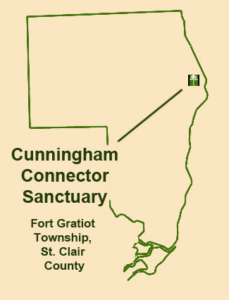
Fort Gratiot Township, Saint Clair County
Acquired 2025 January 10
5 Acres
Fort Gratiot Township, Saint Clair County
Acquired 2025 January 10
On January 10, the TLC closed on our new 5-acre Cunningham Connector Sanctuary on the south side of Carrigan Road in Fort Gratiot Township. Except for having to cross Carrigan Road, this preserve connects our 80-acre Shorewood Forrest Southeast Sanctuary with the 152-acre Fort Gratiot Park to the south. The north end of the preserve had a residence years ago which was demolished, and so was heavily impacted and of very low vegetative quality, now largely covered by invasive Reed or Phragmites. The south end of the preserve still contains intact dune and swale forest, extending south to the 40-acre pond on the Fort Gratiot Nature Park.
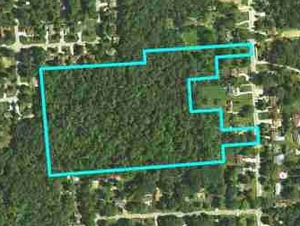
The Cunningham Connector Sanctuary shown in yellow. Purchase of the Cunningham Connector Sanctuary was made possible by funding provided by a long-awaited grant from the North American Wetlands Conservation Council which came through just in time. Ultimately, we thank Kali Rush of the Great Lakes/Atlantic Regional Office of Ducks Unlimited in Dexter, Michigan for this grant opportunity and her continued work on behalf of the TLC.
The Cunningham Connector Sanctuary was one of the few undeveloped parcels remaining along Carrigan Road that allowed for connection to the Fort Gratiot Nature Park, and fortunately, aligns very well with our new trail entrance on the 80-acre Shorewood Forrest Southeast Sanctuary, which means that the public will need to walk only a short distance along Carrigan Road. This is a critical connection for the Southern Lake Huron Coastal Park as it allows for a continuous trail connection extending nearly 2 miles, from the southern end of the Fort Gratiot Nature Park near Keewahdin Road up to Brace Road on the north side of the Shorewood Forrest preserves.
At the property closing, TLC Executive Director Bill Collins had a long discussion with the sellers, Nancy Selby and Mark Cunningham, children of the previous owner, Shirley Cunningham. After their mother retired from teaching science in the Port Huron Area School District, and not long after their father passed away, she started investing in real estate. The Cunningham Connector parcel was the first property she bought to start her new investment career in 2007. Shirley Cunningham loved nature, and Nancy and Mark said that she would be happy to know her parcel would be protected by the TLC.
Previous to the closing, we were already calling the property the “connector parcel”, so in honor of their mother and the Cunnigham family, we decided to name it the “Cunningham Connector Sanctuary”.
Nancy Selby provided the following for The Thumb Naturalist:
The property now known as the Cunningham Connector Sanctuary at 3305 Carrigan Road holds a special legacy. Purchased in 2007 by Shirley Cunningham – a dedicated school teacher of the Port Huron Area School District whose career was marked by passion and care – this land became her canvas for renewal after retirement. Embracing a hobby that transformed into an art form, Shirley lovingly assembled her collection of properties, a pursuit her family playfully likened to a grown-up game of Monopoly.
From her earliest days, Shirley’s heart was enchanted by nature. As a child, she roamed the woods with her beloved grandmother Bertha, absorbing the magic of every leaf and trail. This wonder for the outdoors only grew with time. Alongside her husband of nearly 50 years, David, a fellow nature enthusiast and devoted mentor in Girl Scouts and 4-H, she championed the beauty and preservation of the natural world.
Shirley and David Cunningham at Banff National Park, Alberta, Canada.
Shirley’s lifelong commitment to sharing the splendor of nature with family and friends is woven into the very fabric of the Cunningham Connector. Today, as this cherished property becomes part of the Thumb Land Conservancy, we are comforted by the thought that our dear mother would be proud. Her legacy of nurturing nature, and hearts, lives on in every preserved acre.