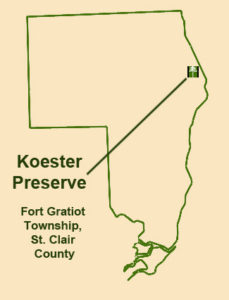
Koester Preserve
79.4 Acres
Fort Gratiot Township, Saint Clair County
Established 2020 April 04
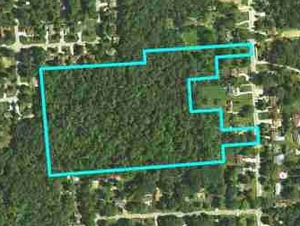
79.4 Acres
Fort Gratiot Township, Saint Clair County
Established 2020 April 04
Darrin and Kim Koester were the second landowners to protect their land with a TLC conservation easement on 79.4 acres of their 84.6-acre parcel. The Koester conservation easement protects one of the larger forest tracts remaining in Fort Gratiot Township and significantly reduced the property taxes on this large parcel. The Koester Preserve includes a large area of relatively mature, non-fragmented southern swamp and hardwood-conifer swamp forest complex on seasonally inundated to moist sands with scattered upland knolls. Wetland vegetation includes Silver Maple, Green Ash, American Elm, Eastern Cottonwood, Bur Oak, Swamp White Oak, American Hornbeam, Spicebush, Dwarf Raspberry, Spotted Touch-me-not, False Nettle, Clearweed, Marsh-marigold, Sensitive Fern, Royal Fern, Spinulose Woodfern, Fowl Manna Grass, Lake Sedge, and Tussock Sedge. Upland vegetation includes Red Oak, Black Oak, White Oak, American Beech, Basswood, Sugar Maple, Red Maple, Tulip Tree, Sassafras, Serviceberry, Witch-hazel, Jack-in-the-pulpit, White Avens, Solomon-seal, Wild Geranium, and Yellow trout-lily. Many of the native forest plant species are typically of a more northern distribution in Michigan, including Paper Birch, Eastern White Pine, Eastern Hemlock, Speckled Alder, Black Chokeberry, Meadowsweet, Low Sweet Blueberry, Dwarf Raspberry, Wintergreen, Goldthread, Canada Mayflower, Wild Sarsaparilla, Foamflower, Wood Anemone, Bracken Fern, Royal Fern, Northern Lady Fern, Ground-pine, and Ground-cedar. Likewise, there are species that are typically more southern, including Black Oak, Sassafras, Tulip Tree, and Spicebush. This sort of southern-meets-northern forest is characteristic of the Blue Water Area, a transitional vegetative region where nearby Lake Huron maintains cooler summers and warmer winters.
The Koesters developed their residence on the north end of the parcel which was cleared decades ago and covered by planted pines along with very common or weedy species such as Apple, Black Cherry, hawthorn, Gray Dogwood, Autumn-olive, Common Buckthorn, Tartarian Honeysuckle, Common Blackberry, Late Goldenrod, Panicled Aster, and grasses. Portions of this area have so many apple trees, it appears there may have once been a small orchard here. The TLC assisted the Koesters in avoiding regulated wetland impacts, identifying invasive shrubs such as buckthorn and honeysuckle, and advised them on invasive weed control methods.
In addition to receiving a substantial local property tax reduction, because of the value of the TLC conservation easement, the Koesters could take a significant federal income tax deduction over 15 years and the property taxes will not be uncapped upon sale.