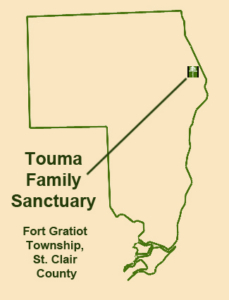
Touma Family Sanctuary
31.62 Acres
Fort Gratiot Township, Saint Clair County
Acquired 2025 October 29
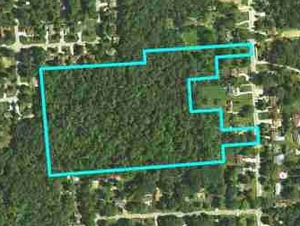
31.62 Acres
Fort Gratiot Township, Saint Clair County
Acquired 2025 October 29
The new 31.62-acre Touma Family Sanctuary is located north of Brace Road at Parker Road and is critical to connecting the north and south halves of the Southern Lake Huron Coastal Park and to routing the coastal walking trail that would connect the Shorewood Forrest sanctuaries with the Water Works Preserve and Peltier Sanctuary to the north. Without acquiring the Touma Family Sanctuary, extending the coastal trail through this area may have been impossible as the TLC had already made purchase offers on adjacent parcels to the east without success.
On 2025 July 09, the TLC received a signed purchase agreement for the property; the purchase price being $200,000 and granting us one year of fundraising time while the owner could continue to list and market the property. In mid September the seller’s agent informed us that they had a better offer, giving us 45 days to close or withdraw our offer. For lack of successful fundraising, we made use of a private loan and closed on the property on October 29.
The Touma Family Sanctuary is located on the western-most dune ridge of the dune and swale complex in Saint Clair County, part of the same ridge that runs southeast to near the Blue Water Bridges and upon which Lakeside Cemetery and Saint Mary’s Cemetery are located. Much of this large dune ridge on the Touma Family Sanctuary was mined for sand decades ago, but most of it remains intact, consisting of a mix of sparsely vegetated dune-like open sand, and wooded shrub thickets with Black Oakand what appear to be Hill’s Oak. This is the site where, several years ago, Ray Peltier pulled a large Eastern Hognose Snake from its burrow in the main sand ridge, the photograph of which the TLC has used in promoting the Southern Lake Huron Coastal Park. As old ground disturbance took the sand ridge on this sanctuary back to more open conditions
that existed centuries ago, it will be interesting to explore in more detail to see what might be remnant here.
Most of the parcel consists of dune and swale forest except open areas on the highest sand ridge and two man-made ponds, one near the center of the parcel and the other at the north end of the parcel adjacent to the Galbraith Drain which flows directly to Lake Huron. The parcel consists generally of about 13 acres of southern swamp forest wetland swales, about 10 acres of mesic to dry-mesic southern forest upland sand ridges, about 6.5 acres of sparsely vegetated open sand, and about 2 acres of ponds and marshy shoreline. Dominant vegetation is typical of the dune and swale forest in this region, the canopy consisting largely of Silver Maple, Eastern Cottonwood, and American Elm, with Green Ash, Black Ash, and other associated understory species of sandy muck wetland swales. The upland sand ridges are dominated largely by Black Oak, Red Oak, Black Cherry, Big-tooth Aspen, and other associated understory species of dry-mesic to mesic sand. The primary invasive weed on the parcel is Reed – Phragmites australis subspecies australis with about 10%, or about 1.5 acre, of coverage concentrated around the ponds and adjacent wetland. Invasive shrubs on the parcel are moderate, with about 10%, or about 1.5 acre, of coverage by Common Privet – Ligustrum vulgare, Tartarian Honeysuckle – Lonicera tatarica, Japanese Barberry – Berberis thunbergii, Asiatic Bittersweet – Celastrus orbiculatus, and Garlic Mustard – Alliaria petiolata.
The previous owner dug extensive ditches that drain wetland swales to the adjacent Galbraith Drain. Multiple field tile lines were also likely installed to drain additional wetland in an attempt to create deer habitat. As part of site restoration, ditches will be filled and tile lines cut and blocked. This drainage appears to have substantially diminished wetland hydrology across the sanctuary, and likely decreased the total wetland size. Restoration of surface water and shallow ground water retention in the wetland swales will improve water quality discharging to the Galbraith Drain which flows directly to Lake Huron less than 1 mile to the east. This will help alleviate downstream flooding, help restore the wetland macroinvertebrate populations which serves as the base of the food chain, and will improve habitat suitability for amphibians, reptiles, birds, small mammals, and other wildlife inhabiting the dune and swale complex on the Touma Family Sanctuary.
The Touma Family – bios, history